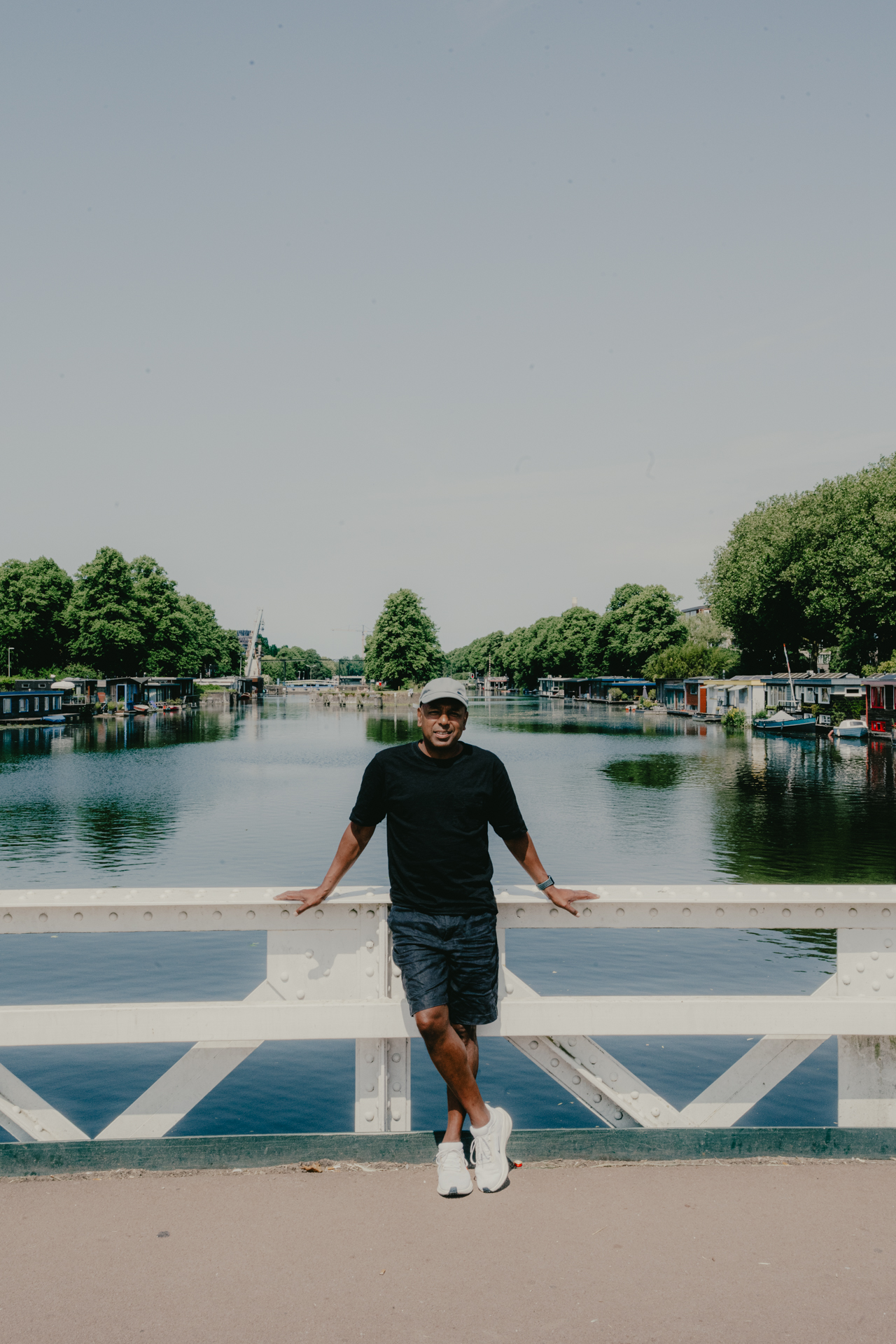
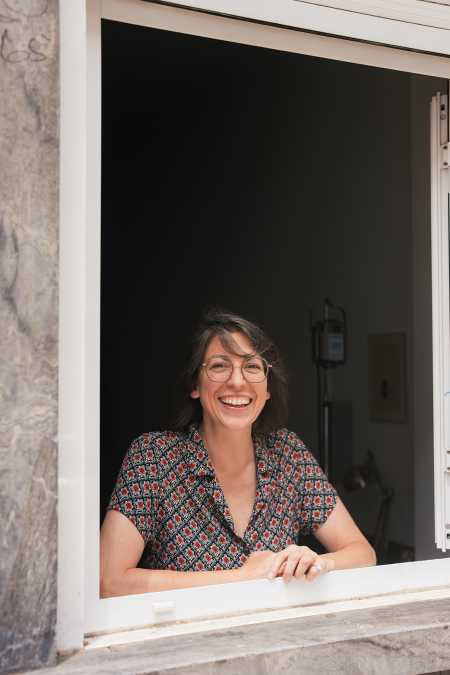
Perhaps the most widely interacted with, yet least visible of personalities at Le Guess Who? is digital designer Ramdath Mos. For ten years he has been digitally translating the LGW experience to visitors through our website, alongside Nick de Kruijk, on coding and programming; introducing both U? and COSMOS to the community, and sharing the vision of the festival to both inform and inspire.
For the occasion of our 20th anniversary, we’re highlighting collaborators whose work makes what we do visible, audible and legible to the rest of the world year after year. Behind the Scenes is a series of one-on-one talks with people who have been involved with the festival for quite some time. Their contribution extends beyond one show or one edition, they are essential to sharing what we’ve created here, and we are thrilled to have the chance to celebrate them and the years of appreciation between us.
Interview by Margaret Munchheimer
Photography by Noah Schielen
For our second Behind the Scenes interview, we sit down with Ramdath Mos. As R A M D A T H, he creates unique digital experiences not only for LGW, but also artists and designers, such as Gijs & Aldo Bakker, as well as cultural and social organizations—rebranding for Jazz Orchestra of the Concertgebouw, art direction for Jazz & Freedom Festival, and web design for Nederlands Film Festival and Big Sounds Amsterdam, among others.
Most importantly, though, Ramdath has been a dedicated LGW visitor for 18 years, and it is the natural chemistry of a shared artistic DNA which grounds his collaboration with the festival. Here, he discusses the 'hip-hop state of mind', why he prefers working with artists, and some of his favorite historical highlights both behind the scenes and beyond.
I thought first we could get into your history with Le Guess Who?, like how long you've worked together and how you encountered the festival in the first place.
In the first place, I'm a music fanatic myself. I think from the early 80s, I listened to hip-hop music fanatically, and I still do. I'm also into jazz and contemporary classical music, and I love the search for new things.
I think 20 years ago, friends of mine from Utrecht went to LGW, and it was one of the first editions with the Canadian Exchange. I wasn't there, but two years later was the first time for me, and every year since 2009 I was a visitor. Around 2014/2015, when LGW was already working with design studio Loudmouth, they introduced me, and Bob and Johan asked: “Hey, you make great websites, do you want to help us?”, so that was the beginning.
Also, how we structured the site and its interaction design: several hidden elements, when you moved the mouse over certain images, the lines in front of and behind the content changed. After a few years, we realized the site was copied by other festivals, so we started with a new design. And I think this is the fourth design we’ve done.
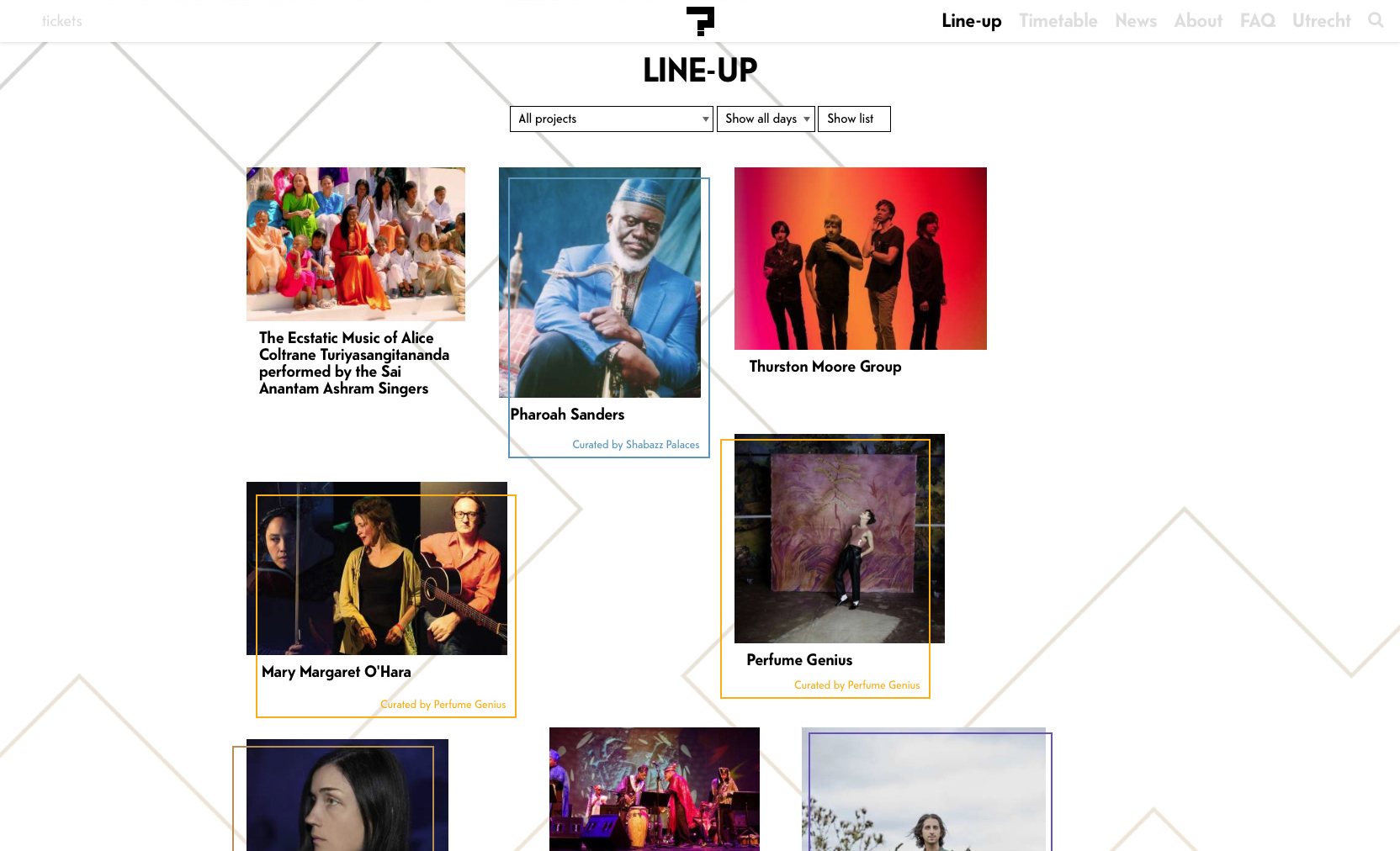
I think it proves that it's good, but you have to be able to keep your own identity. The site is more than a platform, it's part of the identity, so we have to keep changing. Yeah, I love it to be copied, but sometimes it's also exhausting.
So, what kinds of things do you think about when you're deciding what you want out of the site?
I'm an autodidact at this, but the most important thing in my way of thinking is the hip-hop state of mind. So always be original, keep it real, integrity, stuff like that. For me, that’s always there—maybe not in the style, but in the approach, it’s in my DNA. I think hip-hop is the most important way of thinking, together with jazz.
So what’s the jazz mentality?
I don't know, freedom.
Okay, so there's a real direct relationship for you between the music and the work.
Yeah, I'm not an artist in that kind of way, because when it comes to the digital design for LGW, I see myself more as a facilitator than as an artist. But I do think like an artist. For me the process is very important. When I start, I never know exactly what I'm going to do. I make some sketches, then we go into conversation, I get new insights, infuse them, and keep developing the designs. Then we go into prototyping, design further and fine tune. And it's always in development.
Like with the COSMOS website, we've made some improvements this year. A few years ago, we introduced an interactive world map, and I think a lot of people didn't know it was interactive because it looks so nice that you don't immediately know how to navigate it. But this year, we've changed the COSMOS website into more of a news platform. So for example, we’ve added a functional carousel slider; but unlike on other websites, it's based more on swiping behavior.
How do you deal with that question of how much you explain to people and how much you just let them discover on their own?
I don't want to underestimate the users and the public, but overestimating is also not good, you need to search for the good mix. I don't want to explain everything. In my work, sometimes the visuals have to have a mystique or mystery—you have to search. But I think for the COSMOS world map, it was a bit of a pity, people didn't understand it, so we changed it.
I heard something really exciting: there’s an organization that archives digital material, and they've approached you about archiving the website? How does that work?
Yeah, the national library of the Netherlands is archiving the LGW website, and that's very cool. I think they are making snapshots of the whole platform a few times a year, and archiving that, and I think they are going to analyze the cultural value.
How do you think about this reality of digital work, that a lot of the work will disappear at some point—is that something that you think about?
Yeah, I think it's more an acceptance thing, how life is: it’s just gone. It's also about taste—some things are better off erased from this world. But the things which are important to this kind of culture—I think we have to keep those.
What kinds of things do you associate with LGW? What characteristics come to mind when you think about what kind of organization it is—based on your experiences, both going to the festival and also collaborating with them?
For me, I think the most important thing is the mission of LGW, what it stands for—and it's more than only music. This may sound a little too big, but I think it makes humanity better to keep festivals like this. And I'm proud to be part of it.
For the festival itself, I like the idea that they are always improving, and looking for new boundaries; they look for new music from all over the world, but always finding the ‘cherry on the tart’. So in a kind of way, it stands for quality–it's not only ‘strange music’–it's more than that, and it's difficult to explain in English.
In the work that you’ve done together, are there things from over the years that you're particularly proud of, or that, for you, are really special?
During the pandemic, we did the LGW ON/OFF project, it was extreme, and we did it in a very short time. [LGW ON/OFF was three days of continuous online programming in November 2020, complete with artist curated features, films, interviews and footage of live performances, as well as commissioned short documentaries from around the world.]
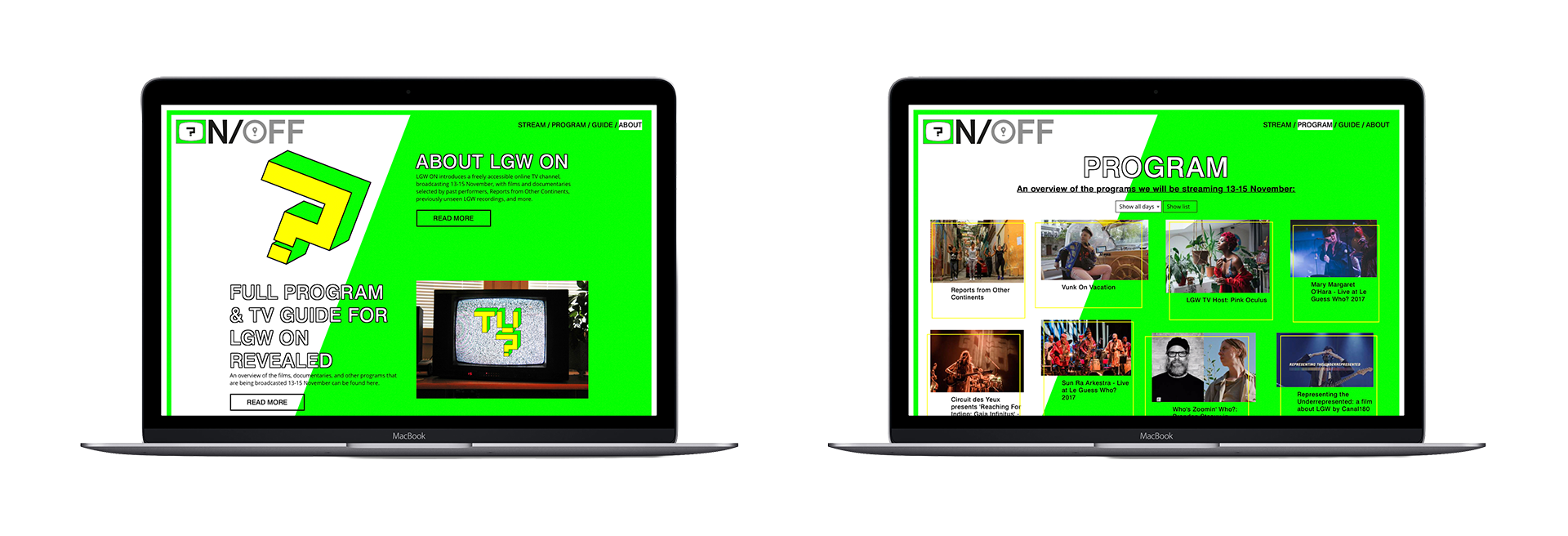
I still love that project; it was amazing. The whole look and feel…it was new. We didn't know what to do, because we wanted to build an online platform for the offline festival, but also for streaming. Yeah, the whole feeling about it was something special, I think, because we were searching for solutions, and we didn't know how the world was developing; and it was a very, very dark time, but the whole platform, it was just joy.
I will say something else about that approach, because I'm not the designer of the festival artwork, but when I started working for LGW, I said there has to be enough room for my creativity. So I get a visual, and that's it. And I like that approach, because I'm not dependent.
Then I sit with Barry most of the time, and later Zsarà—both from marketing—and they've got a lot of trust in the collaboration; always thinking, what works for both parties. That way, we always know it's going to be fine, it's always going to be good, and it's an endless, cycling process.
I think my approach is not that different, but for me, there are a few key elements with my work: I have to like the people. So when there's no chemistry, I don't do it. I also don't do corporate things, so I won't work for Shell or Lays Chips, or something like that.
I like to work for and with creative people because they understand the process of things. They are looking at the world in another way and it's easier to relate. I don't have to explain everything, and they understand what I'm doing.
So, how about any of your favorite LGW stories, or memories from over the years, also as a viewer?
One of my favorite concerts was from Shabazz Palaces, Armand Hammer, clipping. and Death Grips. But also Sun Kil Moon. I still remember it made a great impact on me. And last year Saul Williams, I will never forget that…the whole view and the lights, but also the story—in front of the Dutch people, he's telling about the wall in Wall Street. Ah, it was… Kippenvel (goosebumps).