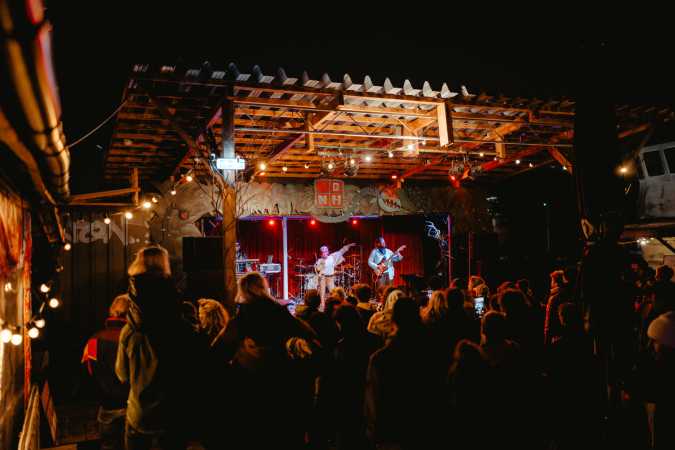
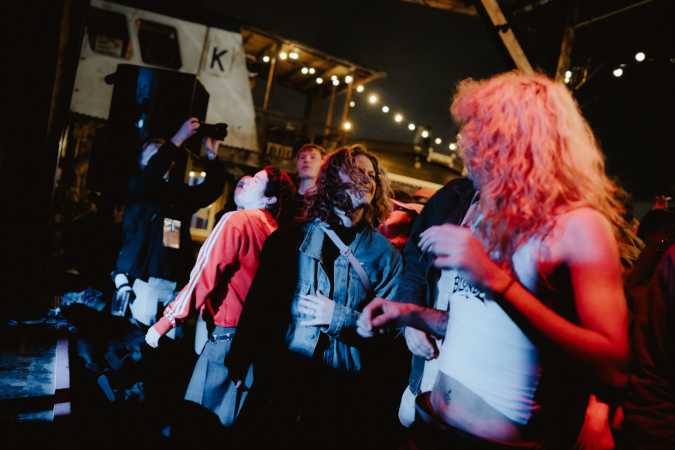
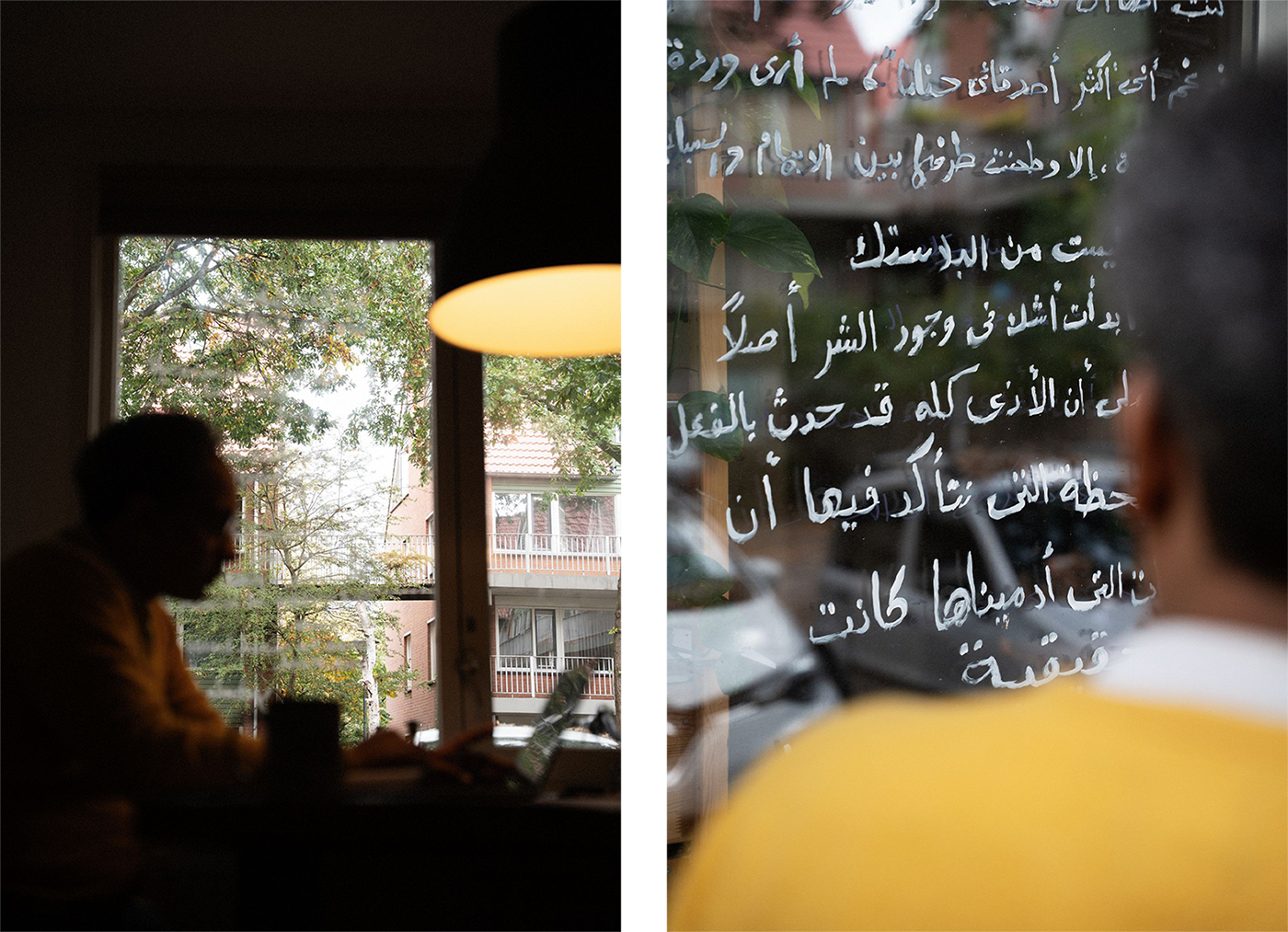
In 2025, De Voorkamer, a meeting space for newcomers and the local community, presented a program at U? that focused on celebrating creativity, community, and connection. Their program featured a workshop organized by performing artist, cultural practitioner, producer, and artist-in-residence Abdalla Daif.
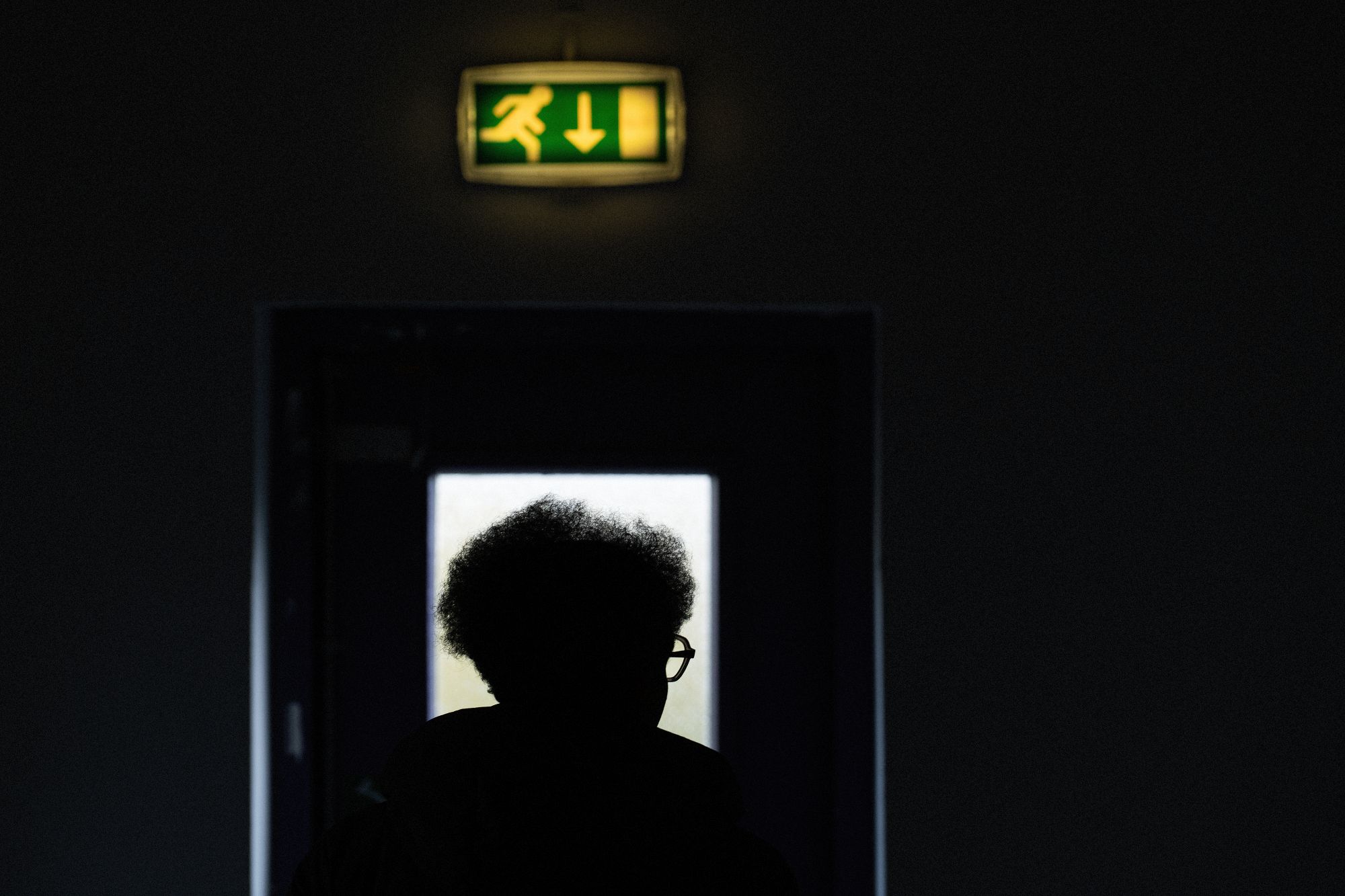
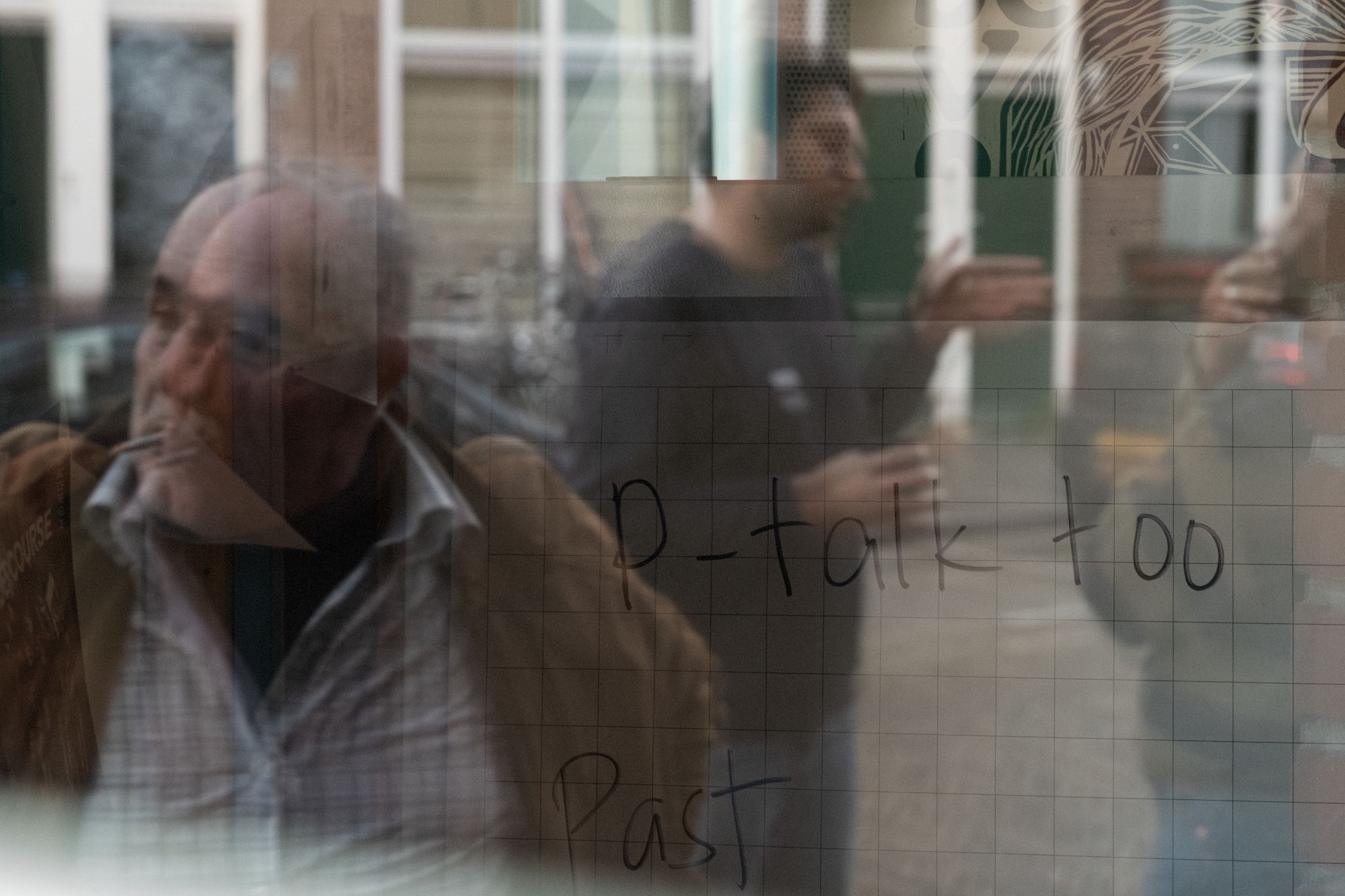
Our residential photographer Rogier Boogaard documented Abdalla Daif during his residency at De Voorkamer. Following the photo series, we talked to Abdalla about his experiences with living and working in Egypt and the Netherlands, about his work that focuses on researching and exploring social and political forms of power and their influence on marginal and neglected events in contemporary life, and, of course, about his residency at De Voorkamer.
At the moment, you go back and forth between Egypt and the Netherlands. How did you end up working and living in these two countries?
I was born, raised, and developed my practice in Egypt, and I came to the Netherlands because of love. I don’t want to sound romantic, but it’s the truth: I am a love immigrant. Yes, I fell in love with a Dutch woman 13 years ago. We lived for seven years in Egypt, then moved to the Netherlands in December 2019, just a few months before the COVID pandemic broke out.
I was born and raised in Alexandria on the Mediterranean coast, where I became involved in the art scene and worked as a multimedia artist and social designer. From 2004 to 2018, I ran a contemporary art organization that used art and creative practices as a way to stimulate critical, imaginative thinking among members of society. My work expanded to include different communities in Egypt, the Arab region, Africa, and Europe. But in 2018, the organization was forced to close its doors as a result of a wave of government restrictions. At that point, my partner—who was also facing challenges in her work in Egypt—suggested that we try living and working in the Netherlands. Over the years I have presented many art performances in different countries, events, and international art festivals.
Does working and living in different places have a major influence on your work?
Yes and no…
Let me start with “no”: my work has not fundamentally changed, because there are global issues that we all share. More specifically, Egypt and the Netherlands face a similar set of issues: migration, water management, threats related to climate change, and a globally shrinking political horizon.
If we look at water management and dealing with the consequences of climate change, we see that the Nile Delta in Egypt and the Rhine–Meuse Delta in the Netherlands face the same risks. Both countries face sea-level rise, fluctuating river floods, and soil salinization. In this context, I have worked on developing joint Egyptian–Dutch projects focused on these questions. Between 2018 and 2020, I founded and directed the project Connecting Deltas, which brought together urban experts and Dutch and Egyptian artists around water management and climate-change challenges. Another project is “Liquid Canvas” (2024–2025), which focuses on bringing Egyptian and Dutch experts and artists together around the concept of urban resilience and managing areas at risk of flooding. The Netherlands has deep expertise in water management, and Egypt has a long history of living alongside water.
When we speak about migration, Egypt hosts about 9 million migrants, around 9% of its population of 104 million. The Netherlands hosts around 3 million migrants, about 16.8% of its roughly 18 million inhabitants. So both countries are dealing with relatively high migration rates. While Egypt’s total area of about one million square kilometers looks huge on the map compared with the Netherlands, only about 8% of Egypt’s territory—some 80,000 square kilometers—is actually inhabited and suitable for life, which is roughly twice the size of the Netherlands’. Here we see similarities in housing crises, rising living costs, and competition for jobs. In Egypt, I presented a performance called The Store that engages with the stories of irregular African migrants before they reach the southern shores of the Mediterranean. In the Netherlands I presented The House of Misconceptions in Leiden, in collaboration with Leiden University, which explores the concept of “othering” and how we construct “the other.” Both performances revolve around the question:
If I answer “yes,” then the impact appears clearly in language, the nature of humor, and sensitivities around social censorship.
In your work, you focus on researching and exploring social and political forms of power and their influence on marginal and neglected events in contemporary life. Can you tell us more about this?
My work explores how social, political, and economic power silences or distorts marginalized stories in everyday life, either by ignoring them or by flooding us with information—for example, informal economies, displaced communities, or suppressed conversations in public spaces.
For example, most of us cannot start the day without a cup of coffee; it is the central ritual that begins the morning. Drinking or buying coffee is an ordinary act in our contemporary European lives, yet it is a direct participation in the hardship of coffee farmers around the world, who live under crushing economic and social conditions. Imagine the situation in the Netherlands—and Europe more broadly—if coffee supplies disappeared or declined because coffee farmers demanded a better life. Let us play roles within this story and see how we might imagine alternative scenarios.
You just finished your residency at De Voorkamer. Can you tell us more about your experiences?
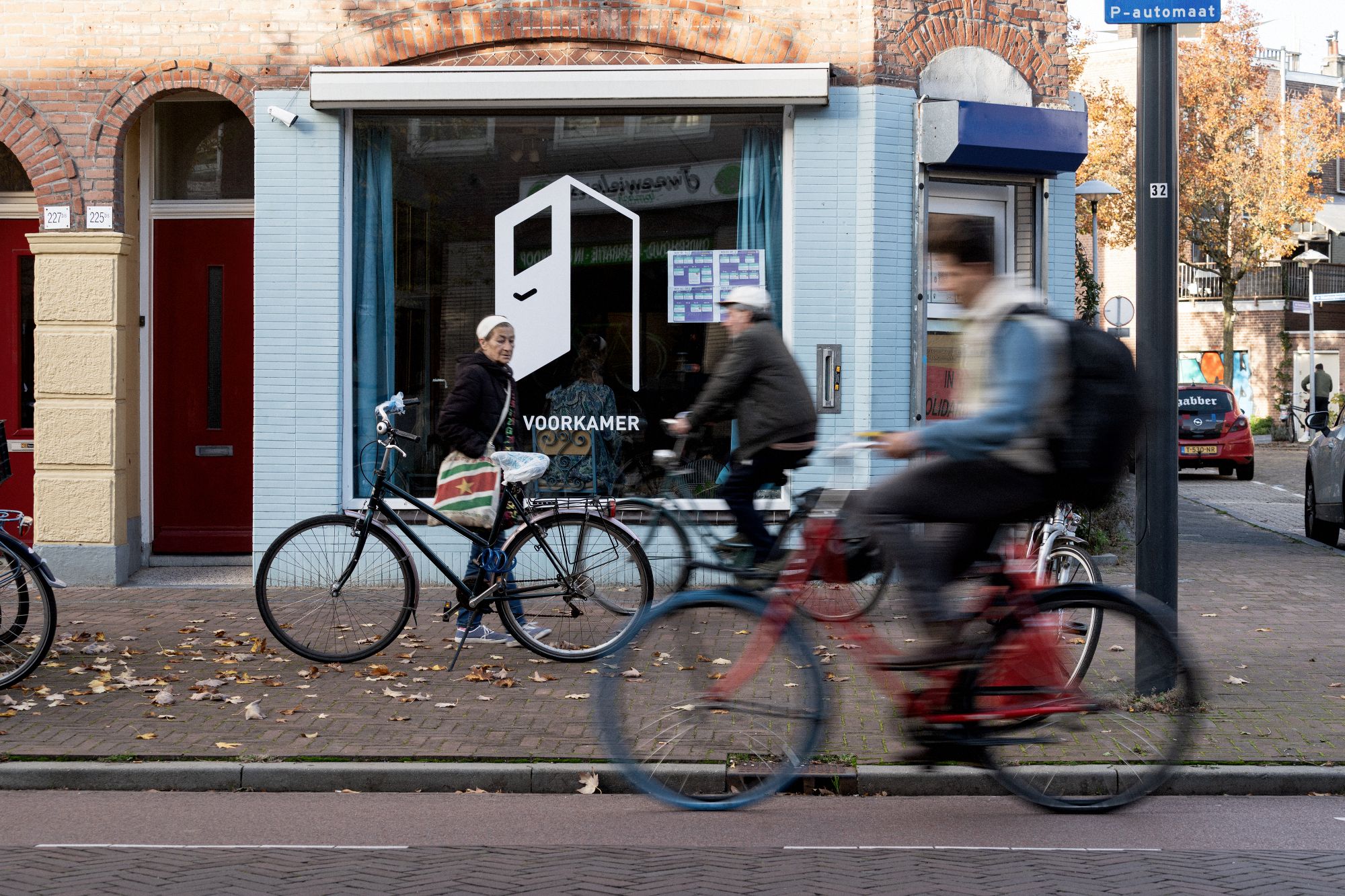
De Voorkamer is a space of encounter between newcomers and the diverse Dutch society. The residency has given me the chance to meet a large and diverse number of residents of Utrecht and its surroundings.
Over three months, I had the opportunity to immerse myself in these questions and work with many migrants, refugees, and asylum seekers.
The world today is witnessing a rise in far-right, anti-immigration discourse, especially in Europe. This reflects a broad social current that views migrants and asylum seekers as an imminent threat to European societies. This perspective appears clearly in the growing nationalist and political rhetoric across Europe, where migrants are portrayed as a danger to national identity and social cohesion, often depicted as a security and social threat and treated through identity politics linked to crime—a phenomenon known as “crimmigration.”
Through my own experience as a migrant connected to migrant and asylum seeker communities in the Netherlands, I have witnessed and experienced the pressures newcomers face. They must navigate between their personal identities and societal expectations in a context that demonizes and criminalizes them and demands their conformity to dominant opinions without regard for their cultural backgrounds and diverse human experiences. They are treated as mere numbers, as people who fled their countries and came to the Netherlands to share the wealth of white Europeans. This happens directly in mainstream political discourse and indirectly at workplaces, in educational settings, with neighbours, and in dealings with institutions such as banks, insurance companies, and others. This leaves migrants and asylum seekers vulnerable to feelings of loneliness, insecurity, rejection, unemployment, and lack of recognition. Here lies the role of De Voorkamer as a space that offers room for dialogue and integration.
You work with interdisciplinary media – is there a format that you focused on during the residency?
I create interactive, multidisciplinary live performances in which I challenge audiences to leave the passive safety of spectatorship and step into unexpected experiences as participants in creating the artwork. I guide audiences toward the spaciousness and confrontation that come from engaging with their own thoughts and those of others.
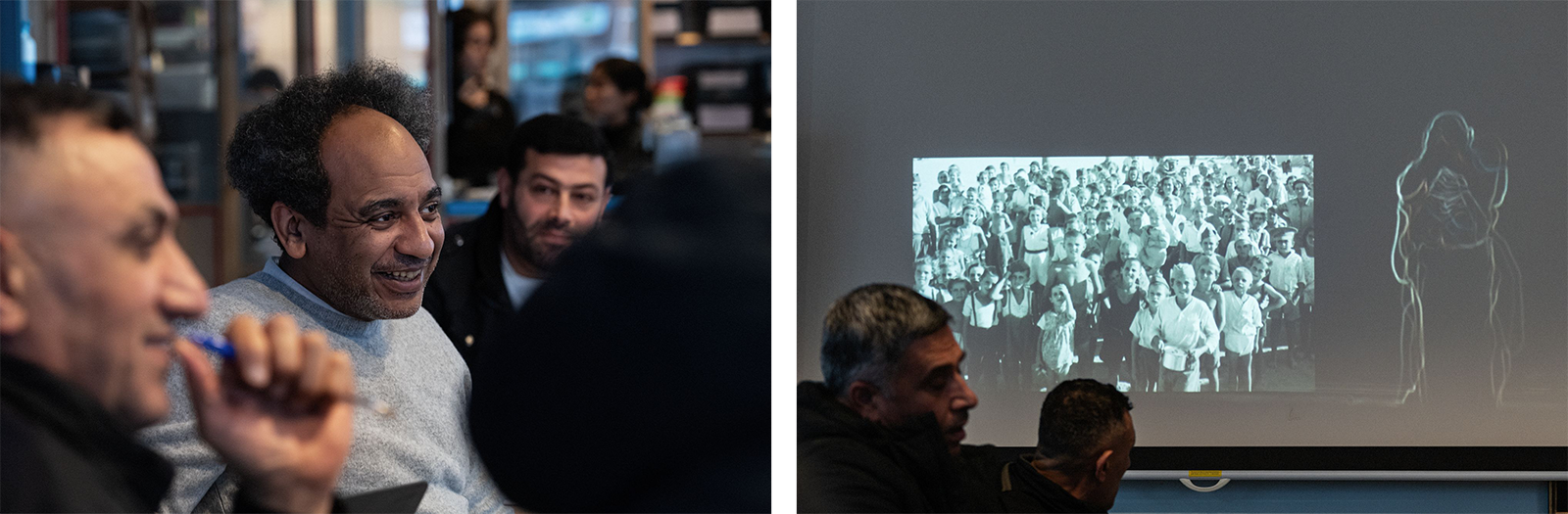
In this art residency, I did the same: I challenged my workshop participants with uncomfortable questions, and they responded through sound, words, and movement, including improvisation among other tools.
What does a place like De Voorkamer mean to you? Do you see what such a place can do to connect people and build a community?
As I mentioned earlier, De Voorkamer offers a space for dialogue and integration and plays a central role in connecting society with newcomers through many artistic, social, and educational activities. It does so without judging participants on their cultural background, class, or gender. I truly hope to see spaces similar to De Voorkamer in cities across the Netherlands.
During U?, you presented Reflective Improvisation. A performance in which you use improvisation as a means to reflect on the emotional costs of migration within the cities where we currently live. How did the audience responded to the performance? Were they able to leave their passive safety as spectators, and step into unexpected experiences?
To begin with, this is not a performance but a theatrical workshop in contemplative improvisation. During this workshop, I focus on the idea of the emotional cost of migration and how it hides in simple, everyday situations that we may not consciously notice but definitely feel. This is especially true in cities and societies that are highly individualistic and self-centered. If you are taking part, you should be ready to face uncomfortable situations that are nevertheless full of surprise.
During U?, I invited participants to leave their real-life identities at the door of De Voorkamer and adopt new characters during the session – it was a chance to “be someone else”. I handed out forms about the character each person would play, and I only defined three things in advance: the character’s name, place of residence and age. For the first 30 minutes they had to immerse themselves in answering a long, detailed list of questions about the character: Do they have a partner? Children? What do they do for work? What kind of music do they like? And so on.
In the next 30 minutes, I conducted interviews with each character in front of everyone, asking questions about how this character behaves in different situations and how they act on a human level. In the following hour, they had to interact with each other in a variety of human scenarios.
What do you hope the audience will take from visiting your performances?
To view current issues from a new angle, question political framing, and challenge invisible dogma’s, to come up with creative solutions, new ideas; their own ideas.
View the full photo series